
My first home was a hotel room.
Two queen beds. Me, my brother, my mom. My dad worked nights so the rent stayed paid. He'd come back when we were asleep and leave again before we woke up. That was the rhythm for four years.
I felt like a king in that room.
None of that was true.
We were broke. My dad worked nights because it was the only shift the family could afford for him to take. My mom ran a household out of one room because we couldn't afford a second. My parents were going through it. The kingdom feeling wasn't the room. It was them. The way two adults held a line so a four-year-old never saw the line was there.
The kingdom was a performance my parents put on so I could have a childhood.
There's a stretch in Pursuit of Happyness where Chris Gardner and his son are homeless. Chris never tells the kid. He turns it into a game. They're time travelers. They're going back to the dinosaurs. The night they have nowhere to sleep, he takes the kid into a subway bathroom. He lays his jacket down. He locks the door. He holds his son in his arms. Someone bangs on the door and he keeps it shut with his foot. The son sleeps.
Chris cries silently against the door. Silently, because if he makes a sound the kid wakes up, and the kid is the only person in the world who cannot know how bad it is.
That is the secret labor of every struggling family. The parent absorbs the reality so the child only sees the version that won't break them. The bathroom becomes a cave. The cave becomes an adventure. The adventure becomes a memory the kid will keep for the rest of his life without ever knowing what it cost.
That was my parents in the hotel room.
The cartoons were the dinosaurs. The hot plate was the cave. The kingdom feeling was the spell.
It was the job that gave them the bandwidth to perform the spell.
My dad had one. That meant we ate. That meant we stayed. That meant the door I walked through every night was a door we got to keep.
He immigrated for a better future. Most immigrants do. They don't come for the food or the weather or the conversation. They come for the job. They come because work here is supposed to mean something the work back home couldn't.
The hotel room was proof the trade was working. Not glamorous. Not stable. Working. Barely.
When I was 12 we moved into a 500 square foot apartment.
By every metric this should have been an upgrade. More square footage. A real address. Walls that didn't smell like other people's lives.
It wasn't. Those years were the loudest of my life. My parents fought constantly. Not about chores. About stability. About whether the trade was still working.
My dad was an immigrant trying to find footing in a country that doesn't make footing easy. The jobs available to him weren't the jobs you build a family on. The fights looked like arguments. They were really shaped like a question:
Is the work going to hold us?
Every immigrant family is asking that. Every family is asking it when the job isn't certain. It looks like yelling. It looks like silence. It looks like the kid in the back room making himself smaller. Same question.
The spell broke. My parents were too tired to keep performing it. The reality came through the walls.
I was 12 when I made a quiet commitment to myself.
I was going to get out. I was not going to live a life of constraints. I was not going to grow up and have my own family asking the question I was hearing through the wall.
You don't tell anyone things like that when you're 12. You just decide. And every year after that bends around the decision.
There's a question I have never stopped asking.
What if my dad had been given the tools to land the right job? Not any job. The one that matched what he was capable of. The one this country had implied was possible when he got on the plane.
What if a recruiter had returned his call? What if someone had told him which doors actually opened? What if the system that decides who gets hired had been built for someone like him instead of around him?
Would the fights have happened? Would my mother have spent a decade carrying weight that wasn't hers? Would the spell have lasted long enough for me to have a childhood instead of an exit plan?
I don't know. No one ever knows. But the question is what built me.
The right job would have enabled my dad. The right job would have given my mother a different decade. The right job would have let them keep the kingdom intact a little longer.
A job, the right one, rewrites the family.
I started my first real company at 18. By the end of that year I was making six figures. My dad's yearly salary in a month.
The first thing I did was pay for my family. Not as a flex. As an exhale. The fights stopped. The work was holding us. The person doing the work was me.
That same company, I was the one hiring. I'd sit across from someone in an interview and know exactly what I was offering. Not a paycheck. Not health insurance. Not a Slack handle.
I was offering them the thing my dad worked nights for. The thing the hotel room was built on. The thing the 500 square feet was missing. The thing that lets a parent kneel in a subway bathroom and turn it into a cave.
A job isn't a transaction. It's a financial instrument that lets you be the person your family can count on. It's the difference between a hotel room feeling like a kingdom and an apartment feeling like a war zone. It's the only mechanism we have for converting effort into safety for the people who love you.
A job is the thing that makes you possible.
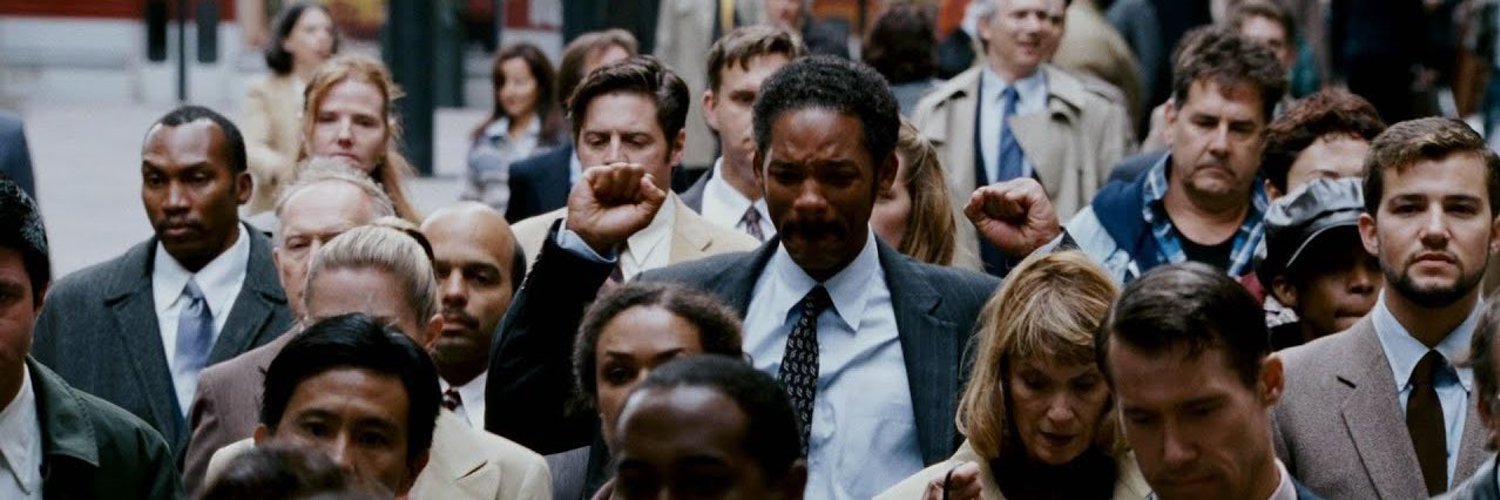
There's a scene at the end of Pursuit of Happyness where Chris walks out of the Dean Witter office after they tell him he got the job. He holds it together inside. He hits the street, walks into a crowd of suits, and starts clapping silently with tears running down his face. None of them know what just happened.
Same man who slept in the bathroom. Same suit. Same arms that held the door shut. The only thing that changed was the job. The job changed everything.
Flows is being built to get a billion people hired.
That's not a number from a deck. That's a debt I'm paying back to a version of my dad walking home from a night shift in the dark.
A billion people are asking the same question my parents were asking. Is the work going to hold us? Most aren't getting an answer. The system that decides who gets hired wasn't built for them. It was built for the top 10% who already know how to play it. Everyone else is left guessing.
LinkedIn turned into a $700B ad business selling subscriptions to people who can't get a callback. Recruiting agencies built armies of salaried humans doing manual searches. AI tools optimized the wrong side. Spam apply for the candidate. Screening filters for the company. The system replaced signal with volume and called it progress.
The candidate side is broken. That's the side I'm rebuilding.
Not because it's a market opportunity. Markets are downstream of the real thing.
The real thing is that somewhere right now there is a parent in a bathroom telling a kid it's a cave. A father working a shift that doesn't quite hold the family. A mother running a kingdom out of a single room and hoping the kid never finds out what it cost. The system that decides whether any of them get a real job was not built with them in mind.
A job is a given right.
It's the foundation of every family that ever had a chance. It's the difference between the version of you who provides and the version who can't. It's the most basic infrastructure of a life, and the system that decides who gets one was built by people who never had to wonder if the answer was no.
Flows is being built so a billion more people get the answer my father gave us. So a billion more parents walk out of an office one day, hit the street, and clap silently in a crowd that doesn't know an entire family just got rewritten.
That's the whole project.
Abdullah Atif, Founder at Flows